
Coach Assist
From Open-Ended AI Chatbot to Focused Coaching Intelligence
Role
Senior Product Designer
Timeline
Apr’ 2025 - Sept’ 2025
Platform
Web Application
Company
Lytx
Challenges
Safety data was abundant, but turning it into coaching insight required too much effort.
Lytx collects extensive safety data across driver events, video footage, risk trends, and coaching history. But this information was distributed across multiple parts of the system. Coaches had to manually piece together the story behind a driver's performance.
As a result, coaching sessions often focused on whatever data was easiest to find rather than what mattered most.
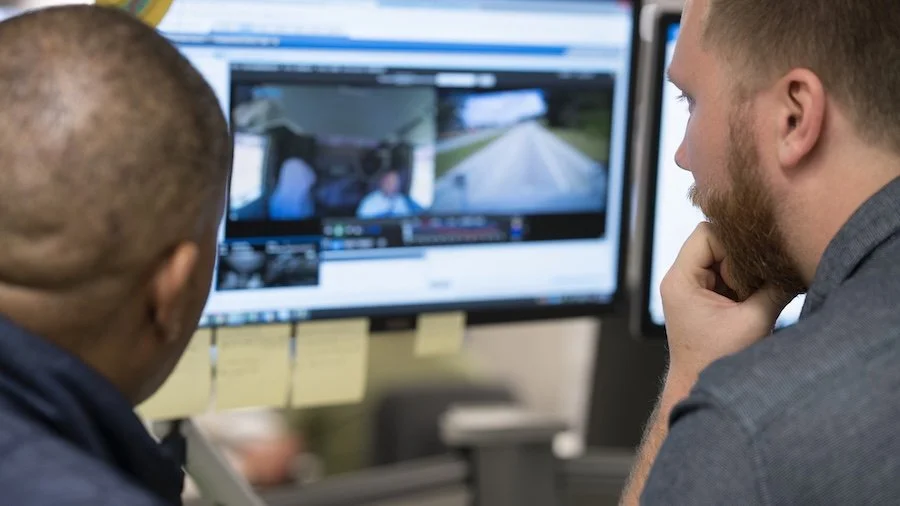
“I'm flipping between 3 different tabs trying to figure out what I should focus on before a coaching call."
- Fleet Safety Coach, Enterprise Customer
Discovery
Across 8,891 survey responses, 6+ enterprise interviews, competitive benchmarks, and live observation, we studied how coaches managed drivers end-to-end. Session preparation emerged as the clearest pain point and the most solvable one.
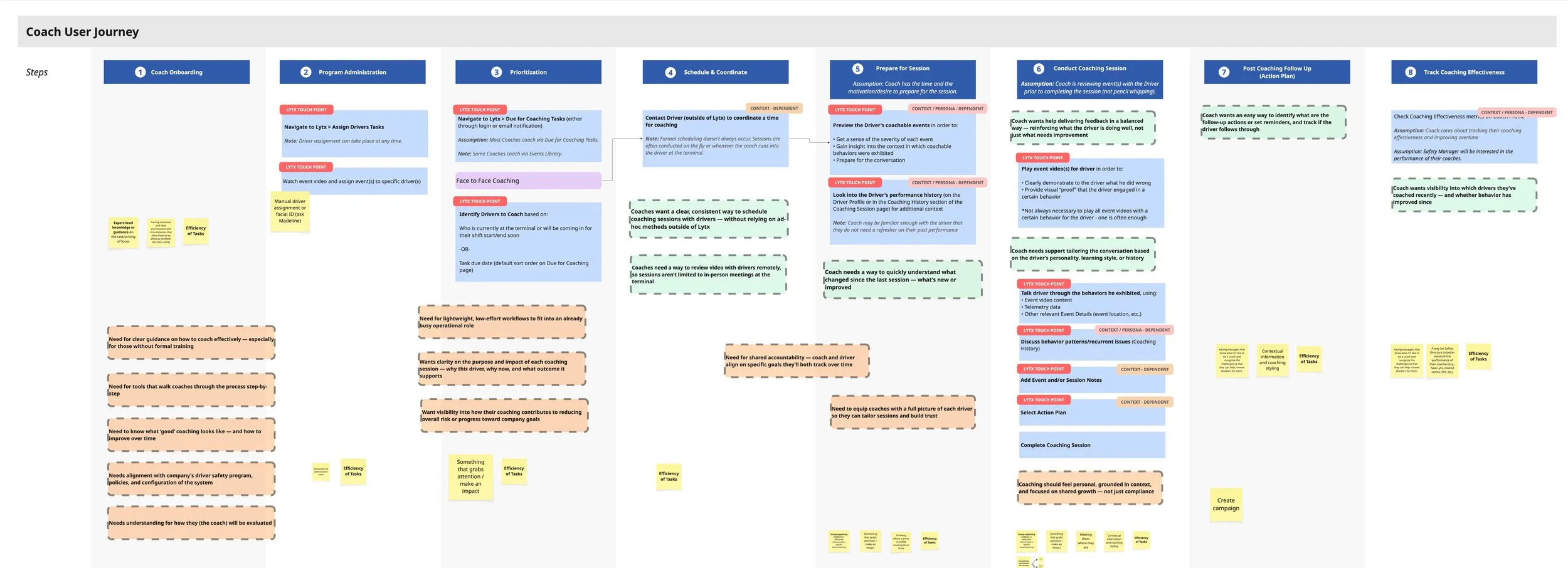
To better understand the problem, we mapped the full coaching workflow to find where coaches got stuck most.
User Interviews
Coaches described session prep as “detective work”—stitching clues across disconnected screens.
Product Analytics
Usage patterns suggested many sessions began without coaches reviewing driver events or history beforehand.
Survey Analysis
Across 8,891 responses, the top frustration was fragmented safety data and lack of clear pre-session guidance.
Competitive Analysis
No fleet platform offered AI-driven coaching preparation, leaving the space wide open.
Key Insights
Coaches didn't need more data, instead they needed help interpreting it.
Through interviews and workflow observations, it became clear that coaches were not struggling with not enough information. The real challenge was interpreting signals across time and context.
Coaches needed to answer a few critical questions before every session:
What should I as a coach focus on addressing in this call?
What behaviors are becoming patterns?
What has changed since the last coaching conversation?
Are there any positive items that I can reference to make the call more productive?
Design
Challenge
How might we help coaches quickly understand what matters before a coaching conversation?
The goal became helping coaches enter conversations with a clear understanding of driver behavior without requiring extensive manual analysis.
However, introducing AI raised an important design question: should the system provide open-ended exploration, or should it focus on actionable guidance? This tension shaped the direction of the solution.
Exploration
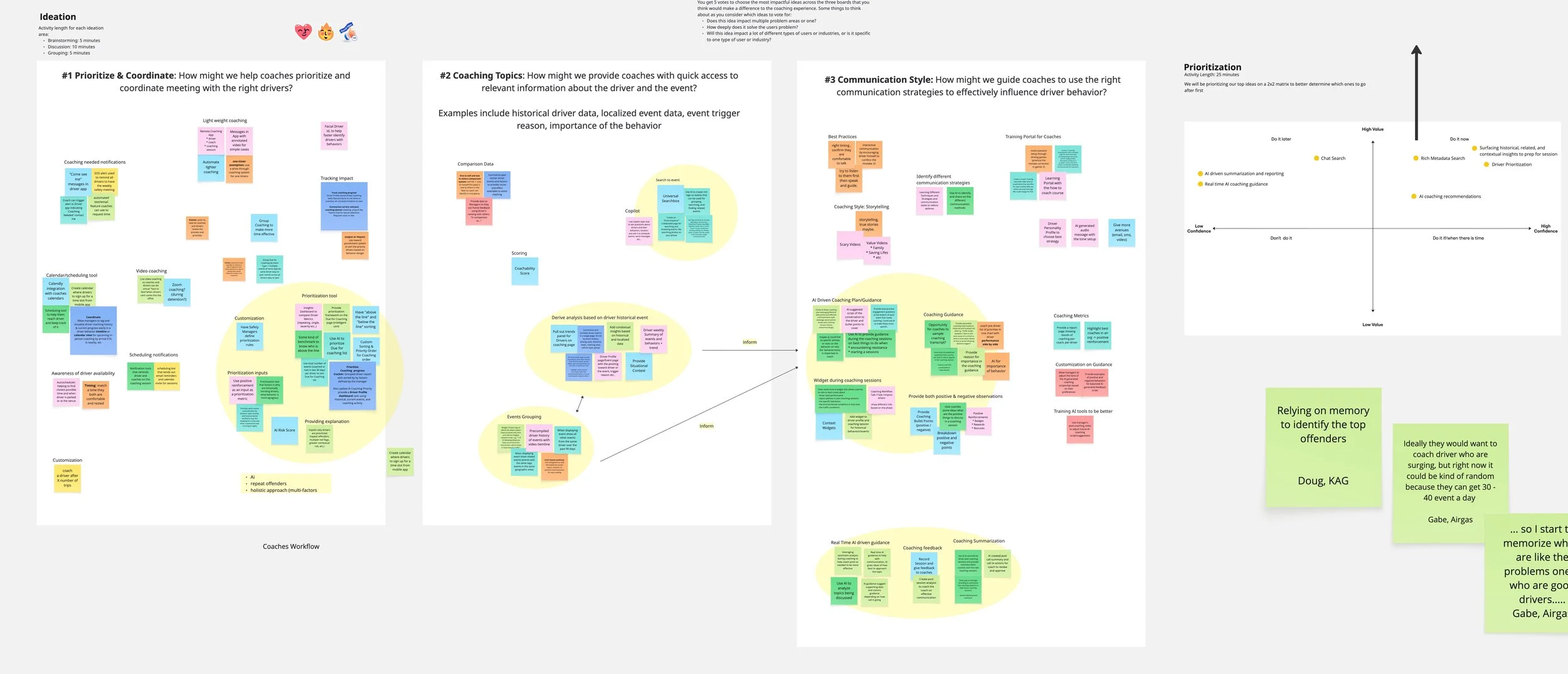
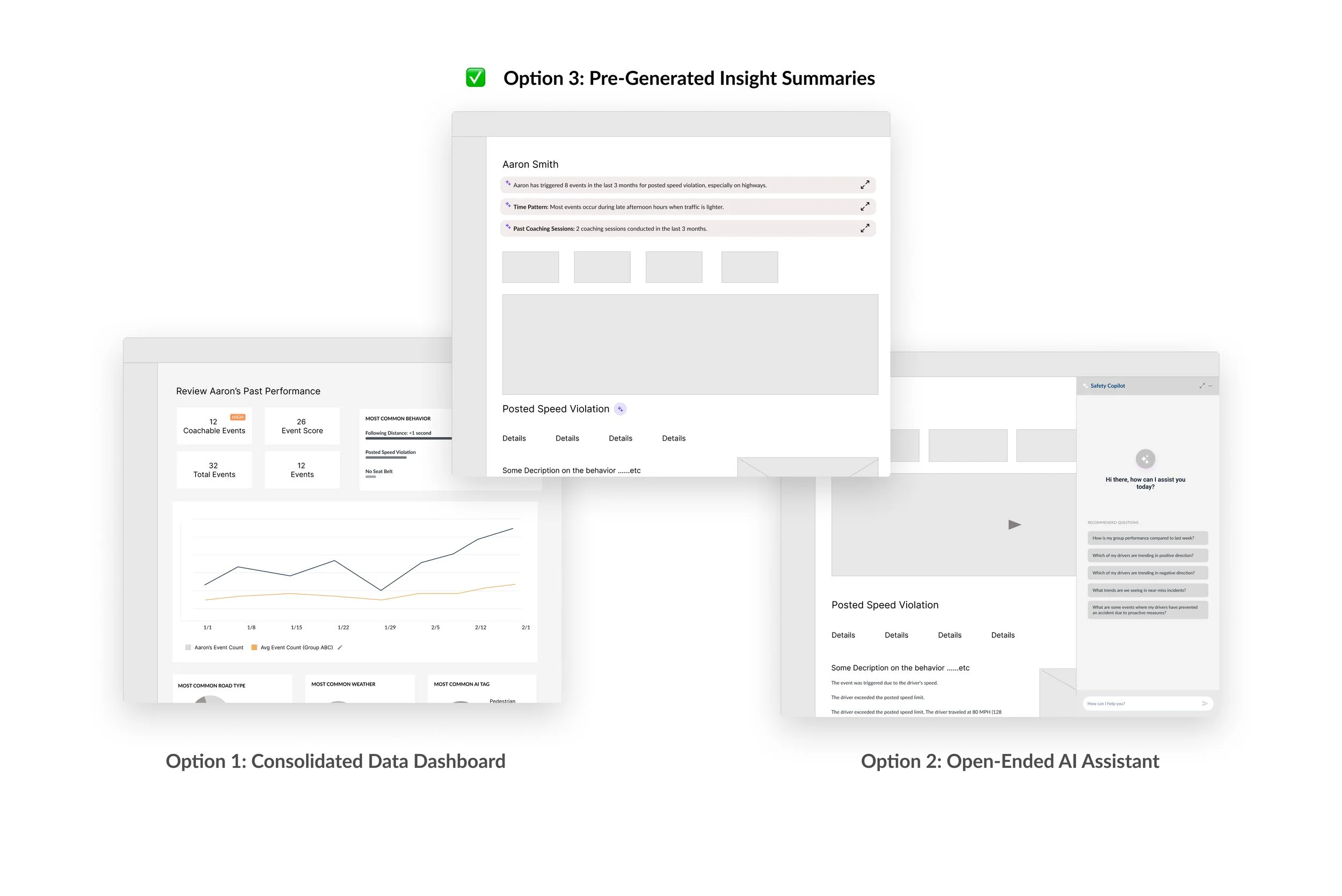
We evaluated three approaches to helping coaches prepare for sessions.
Each approach represented a different tradeoff between flexibility, reliability, and the effort required from coaches.
01
Consolidated Data Dashboard
Pull tables, graphs, and event lists into a single coaching view.
✅ Everything in one place
✅ Low technical complexity
❌ Coaches still interpret data themselves
❌ Doesn't solve the pattern recognition problem
02
Open-Ended
AI Assistant
A conversational copilot where coaches ask any question about driver behavior.
✅ Flexible exploration
✅ Broad analytical capability
❌ Inexperienced coaches won’t know what to ask
❌ Inconsistent, sometimes hallucinated outputs
03
Pre-Generated Insight Summaries
Automatically generate focused summaries around key coaching insights.
✅ Instant, no prompting required
✅ Predictable, trustworthy output
✅ 90% of coaching questions covered by 5 topics
❌ Less flexible than open-ended search
Strategic
Direction
Coaching conversations often happen under time pressure, and coaches need to enter them prepared rather than exploring data during the session.
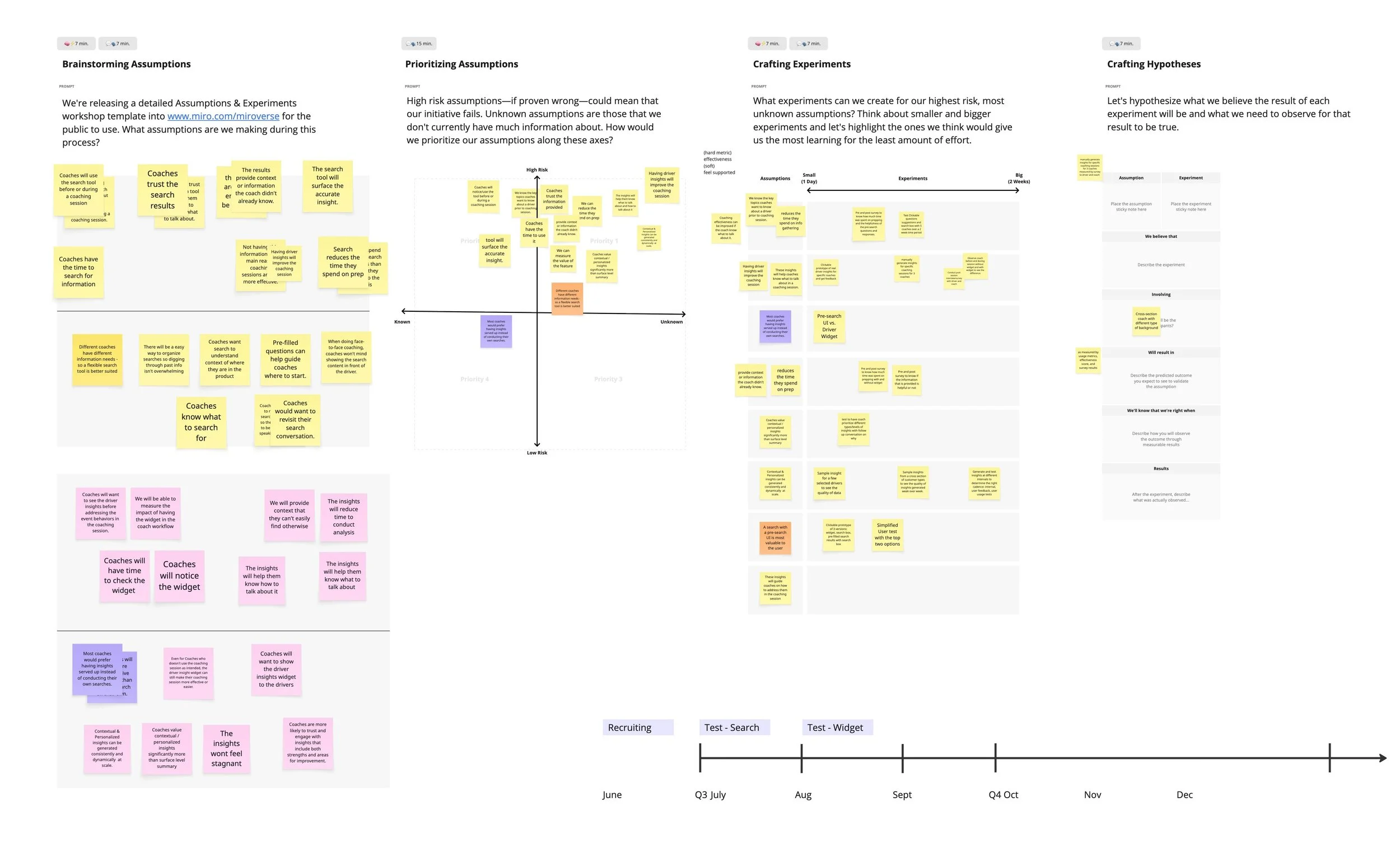
Rather than building an open-ended AI interface, we chose to generate pre-scoped insights grounded in known safety signals. These insights could be surfaced instantly and written specifically to support coaching conversations.
In this model, AI functions as a system capability that synthesizes signals, rather than an interface the user must actively manage. This decision intentionally trades flexibility for trust and actionability in high-stakes moments.
We decided to focus on designing AI for trust and action, not open-ended exploration.
Solution
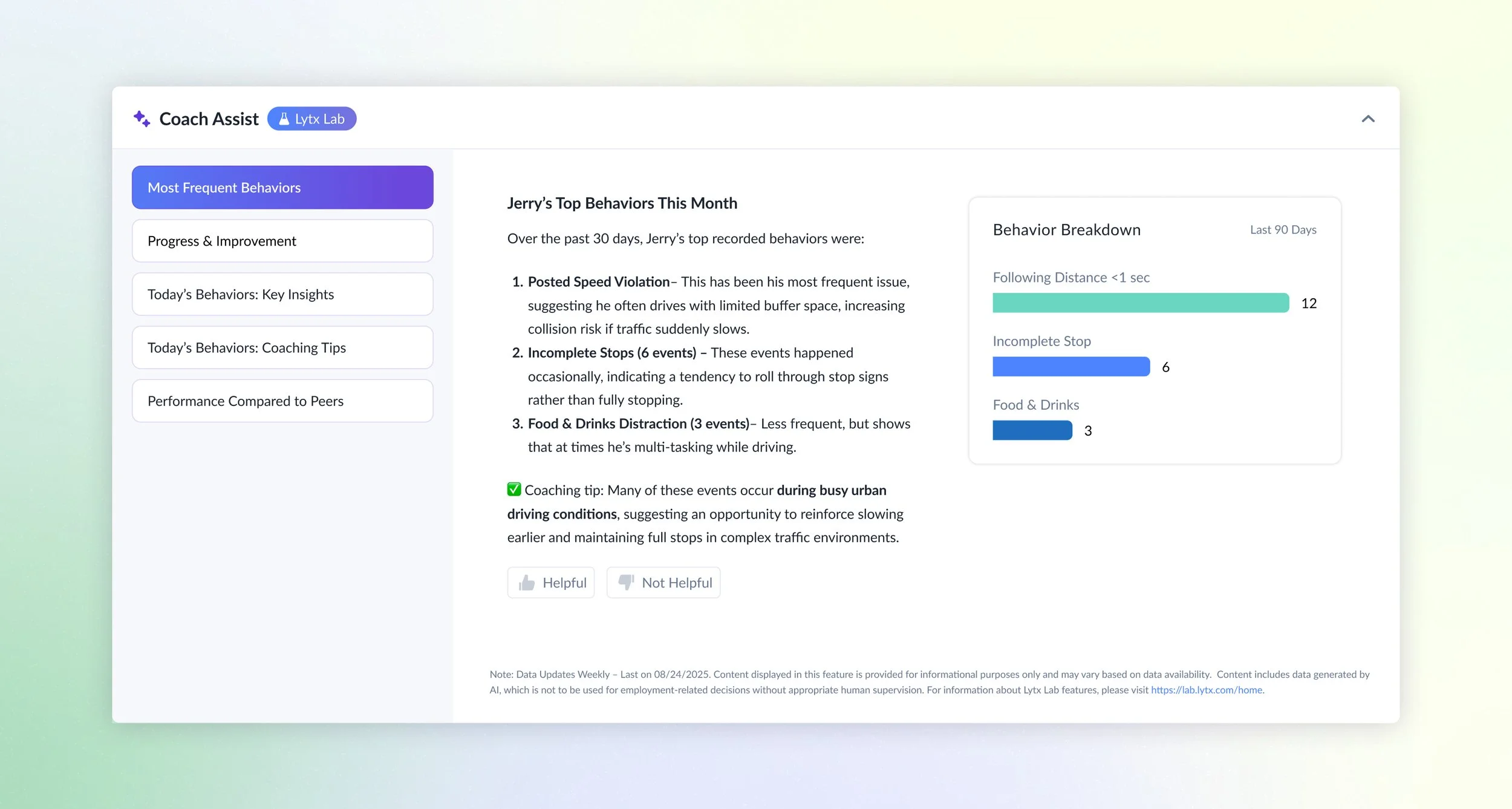
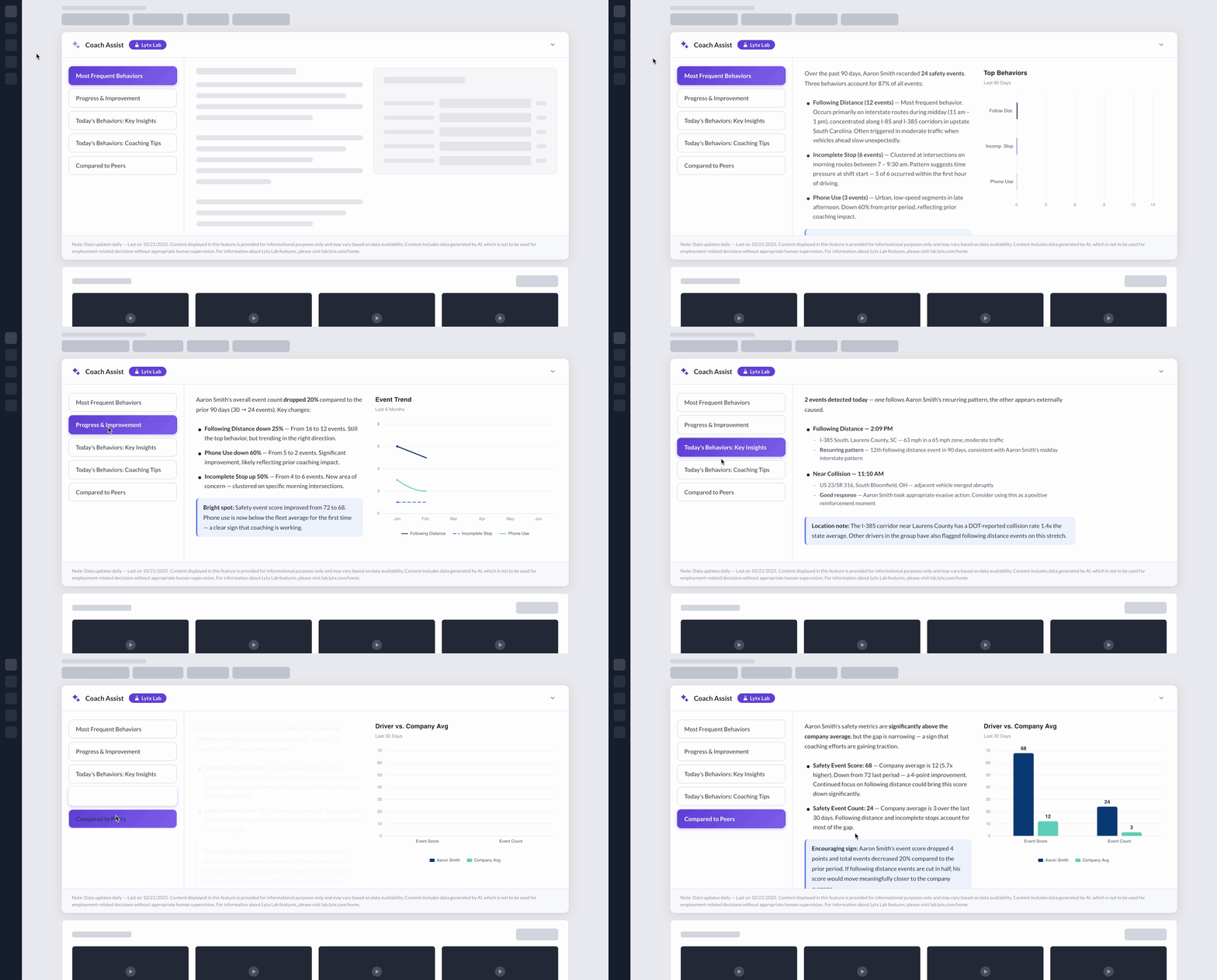
Coach Assist helps coaches prepare for driver conversations with pre-generated, actionable insights.
The experience focuses on helping coaches quickly understand emerging behavior patterns, changes since the last coaching session, and suggested coaching focus areas. Insights are generated from trusted safety signals and presented in a format optimized for scanning rather than exploration.
Impact
Pilot customers reported faster preparation, clearer sessions, and improved coaching outcomes.
We ran a pre/post survey across 13–15 pilot coaches at 5 fleet companies.
Despite 100% of coaches already doing prep work, only 23% felt "very prepared" going into sessions. Again, the gap wasn't effort, it was insight quality. After using Coach Assist:
92%
found it more effective than their existing prep process
80%
used it every or most sessions — without being required to
92%
liked feature: "Highlighted insights I might not have noticed"
"The tool has cut both coaching prep and session times by about half."
- Fleet Safety Coach, Enterprise Trucking Client
Reflection
What this project reinforced about designing with AI
Design the data, not just the UI
Reliable AI outputs start with structured inputs. Understanding the data pipeline was just as important as designing the interface.
The most effective AI feels invisible
The most effective AI features do the thinking so the user doesn’t have to. In time-constrained workflows, pre-generated insight beats prompting every time.